Presentation given at a training course on Critical Minerals, organised by the University of Melbourne, 17th March 2026
Click on the following to download the presentation …
Critical Minerals – Copper March 2026
I was invited to give a talk on copper at a training session for undergrad & Masters students. The 5-day course was organised by the School of Geography, Earth and Atmospheric Sciences at the University of Melbourne and covered a wide range of topics related to Critical Minerals. My focus was to provide a high-level overview of the distribution of copper deposits in Australia and around the World and discuss the general trends and issues associated with their discovery.
The key observations are:
- The need to increase the rate of copper discovery is based on the fact that metal demand is doubling every 20-30 years. Over the next 30 years the World will consume more copper than that mined in all history.
- Around 1360 significant primary copper deposits have been found since 1900, containing ~4200 Mt of Cu metal.
- The majority of the discoveries are located along the Cordillera Belt in North & South America
- Average grades are slowly declining over time and is currently running at around 0.41% Cu for open pit and 0.85% Cu for underground discoveries.
- Industry is progressively exploring under deeper cover. Over the last 50 years the average depth of cover rose from 54 to 202 metres.
- In terms of the types of deposit style found the main one (at the global level) is Porphyry – which is associated with 45% by number of deposits discovered and 70% of copper metal found.
- With regard to the preferred method(s) of discovery, at the Project-scale (i.e. driving the decision on where to take up exploration tenements), over the last 100 years the main method has evolved from simple prospecting to more rigorous searching along-strike from known mineralisation (i.e. so-called “Nearology”). At the Prospect-scale (i.e. driving the decision on exactly where to drill the discovery hole on the tenement) the main exploration tools is now geophysics – especially so for deep targets.
- Between 1985-2005 global spend on copper averaged $0.9 billion (in constant Dec 2025 US Dollars), before peaking at US$7.8 billion in 2012. It is currently running at US$3.6 billion. Even though spend is up by 4x (compared to 30 years ago), the average number of discoveries went down by 2x … leading to significant increase in unit discovery costs. It now costs ~US$500m to make a significant copper discovery, with an average cost per tonne of copper metal found being ~$100/t. Given the modest size of most companies’ exploration budgets, the likely probability of finding a significant copper deposit in a given year is very low.
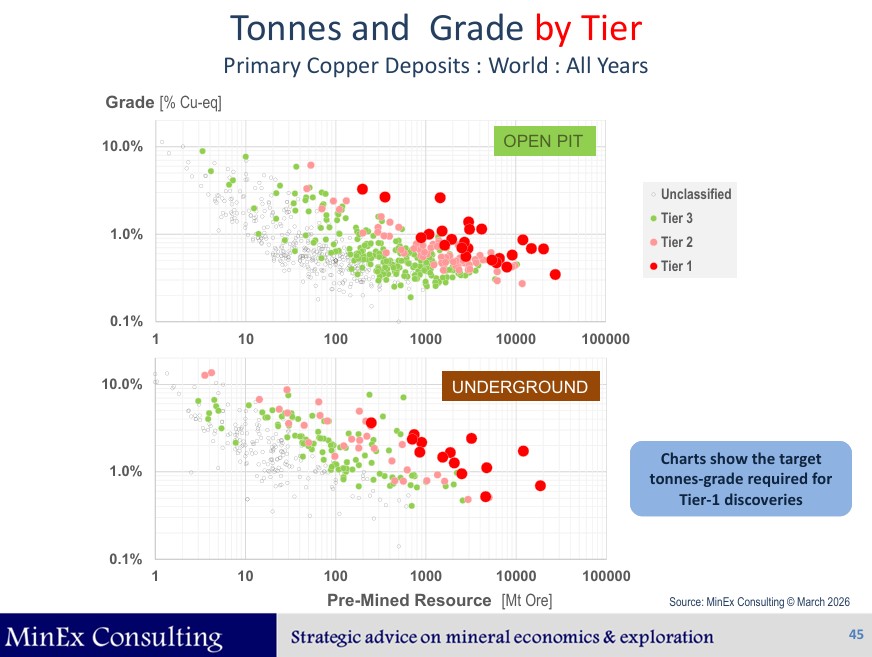
- Tier1 discoveries are rare (making up less than 3% by number) but capture 50% of the value created by industry. If you want to make your fortune, these are the ones you need to find. When compared against the amount of money spent exploring and evaluating discoveries, the last 50 years, copper exploration has shifted from being a value-adding exercise to a just a break-even investment. There are a wide range of factors behind this decline.
As a rough guide for explorers, the minimum tonnes & grade required for an open-pit Tier1 discovery is 1 billion tonnes ore @ 1% Cu dropping to 0.5% Cu at 10 billion tonnes. The Tier 1 threshold for an underground discovery is 1 billion tonnes @ 1.5% Cu dropping to 1.0% Cu at 10 billion tonnes.